A police department in a small Ellis County town recently joined a familiar nationwide law-enforcement “campaign” defending Flock cameras: they do not record continuously, monitor people or track individuals — they merely capture vehicle information at a fixed place and time. But enough of those “fixed” data points, stored and searched together, can reconstruct a person’s movements and routine. Calling it vehicle information does not make it any less like surveillance — the cameras record a vehicle’s plate, appearance, location and time. The information becomes searchable.
City of Midlothian says its Police Department can access readers operated by law-enforcement partners “across the region, state, and nationally.” Waxahachie approved the installation of Flock cameras in 2023. Ellis County is not dealing with a few isolated cameras. Local drivers are entering a much larger surveillance network.
One camera capturing your car once is ordinary observation — like a street photographer unintentionally including it in a photograph, or your vehicle appearing in someone’s dashcam footage. Flock is different. A network that repeatedly records your vehicle near your home, workplace, doctor’s office, church, gun store, political meeting or another person’s house can reveal your habits and routine. It does not need to record every mile. Enough data points create a map of your life.
In Texas, police generally don’t need a warrant — and requiring one would still not be enough
Under current law in Texas, police generally do not need a warrant before searching historical license-plate-reader records. Courts have upheld warrantless access to limited plate-reader data, although whether the same rule applies to extensive, long-term searches across a nationwide camera network remains unresolved.
Requiring judicial approval would be an important safeguard, but a warrant requirement governs only when, why and within what scope police may search the database. It does not answer the deeper question: Why should the database exist at all?
A warrant does not stop cameras from photographing every passing vehicle. It does not give innocent drivers a choice. It does not prevent millions of records from being created so that police might want one of them later.
This is surveillance by default. Everyone is recorded first. Suspicion comes afterward. Supporters argue that license plates are visible in public and therefore are not especially private. Individually, that is true. A plate seen at one intersection reveals little. But privacy is often destroyed through accumulation. A grocery receipt is not deeply personal. Neither is a single internet search, store visit or location ping. Combine enough of them, and they can describe a person more accurately than that person’s friends can.
Misuse and bad judgment are not hypothetical
Former Costa Mesa (California) police officer Robert Josett pleaded guilty after authorities said he used Flock cameras and other confidential databases to track his wife, his mistress and romantic rivals. An audit trail may help catch an officer afterward. It cannot make the victim’s location private again.
The San Diego case involving Hugo Parra and Ariel Beltran shows a different danger. Police were looking for a red Alfa Romeo after an attempted carjacking. A Flock image showed a similar vehicle approximately five miles from the crime scene — information that should have raised doubts about whether it was the same car. Officers arrested Parra and Beltran anyway. No weapon was found, the charges were dropped, and Parra spent nearly a month in jail. Their civil allegations remain unresolved.
In this case, modern technology did not prevent bad police work — the camera just amplified it. Instead of conducting a thorough investigation, officers took the easier path, and the camera’s “evidence” gave their tunnel vision a foundation.
What if the cameras themselves are compromised?
Some politicians warn that Chinese cars could spy on Americans because cameras and other systems may expose sensitive data to foreign governments. But the same caution should apply when American governments install networked cameras that continuously collect and transmit vehicle locations.
The danger does not require bad intentions from Flock Safety or police officials. Researchers have documented security flaws in Flock cameras involving weak diagnostic protections, hardcoded credentials and sensitive information stored in device software. These attacks required physical access and did not show that Flock’s central systems had been compromised, but no system connected to the internet is invulnerable. A database valuable to police would also be valuable to stalkers, organized criminals and foreign intelligence agencies. There is no evidence that such actors have accessed any data yet — but once our movements are collected, even honest officials and responsible companies cannot guarantee that only the intended people will ever see them.
Members of Congress have also raised concerns. Senator Ron Wyden (D-OR) and Representative Raja Krishnamoorthi (D-IL) urged the Federal Trade Commission to investigate Flock Safety after malware has stolen credentials for at least 35 Flock customer accounts. They warned that stolen law-enforcement credentials could potentially provide unauthorized access to plate-reader systems and other restricted information.
What happens when someone finds a commercial use?
Flock’s current license-plate-reader policy says it will not sell, exchange or disclose a customer’s LPR data for commercial purposes. That should be acknowledged clearly.
But Flock already markets separate traffic-analytics products to businesses. Its retail materials promote technology that can show companies how vehicles move through their locations. That is not evidence that police plate data is currently being sold. It does show that vehicle movement has commercial value.
Would anyone be surprised if this technology — or a future competitor — eventually offered corporations more? Traffic measurements. Repeat-visitor analysis. Estimates of where customers came from. Comparisons between vehicles visiting one store and vehicles appearing near a competitor.
Again, that is not an accusation that Flock currently sells police data for those purposes. It is a question about infrastructure. Once cameras, databases and national connections are established, the next debate is rarely whether tracking should exist. It becomes who should receive access, what new purpose sounds reasonable and how much the government or vendor can charge for it.
Policies change. Contracts change. Companies are acquired. Technology created for one purpose has a habit of finding another. And once a surveillance system becomes normal, it becomes much harder to remove — especially after police begin relying on database searches instead of traditional investigation, cities discover revenue opportunities in traffic data, and officials grow comfortable attending vendor-funded “public safety” seminars at resort hotels. We did not reach that point yet, but it is not difficult to imagine how quickly a useful tool could become a permanent surveillance industry. That future is not inevitable — but it is unmistakably dystopian.
Where is the "reject all" button?
Texas gives consumers rights to opt out of targeted advertising, personal-data sales and certain forms of profiling by covered businesses. But the Texas Data Privacy and Security Act specifically does not apply to state agencies or political subdivisions such as cities.
Online, lawmakers tell companies to provide privacy notices and opt-out mechanisms. On the road, the government photographs your vehicle without asking and offers no equivalent choice. There is no “Reject all tracking” button.
Vandalism is not the answer. It turns a public-policy fight into a criminal case and can leave taxpayers paying for the damage or replacement. The answer is organized political pressure strong enough to cancel the contracts, cut the funding and take the cameras down.
Congressional opposition is growing. In April 2026, Rep. Thomas Massie (R-KY) and Rep. Lauren Boebert (R-CO) introduced legislation addressing warrantless license-plate-reader surveillance. Massie has since announced a separate proposal that would withhold federal funding from municipalities and police departments that continue using Flock-style surveillance cameras. The newer proposal is not law, and its final language remains to be seen.
Waxahachie, Midlothian and other local governments should end these contracts and remove the cameras. Texas lawmakers should go further and ban use of automated license-plate-reader surveillance. We may not have a reasonable expectation of privacy in every isolated moment, but that does not mean we expect — or should accept — being digitally tracked over time.
Mike Kelner,
Chief Editor of The Ellis Feed
Opinion: Left Your House? Welcome to the Surveillance Zone
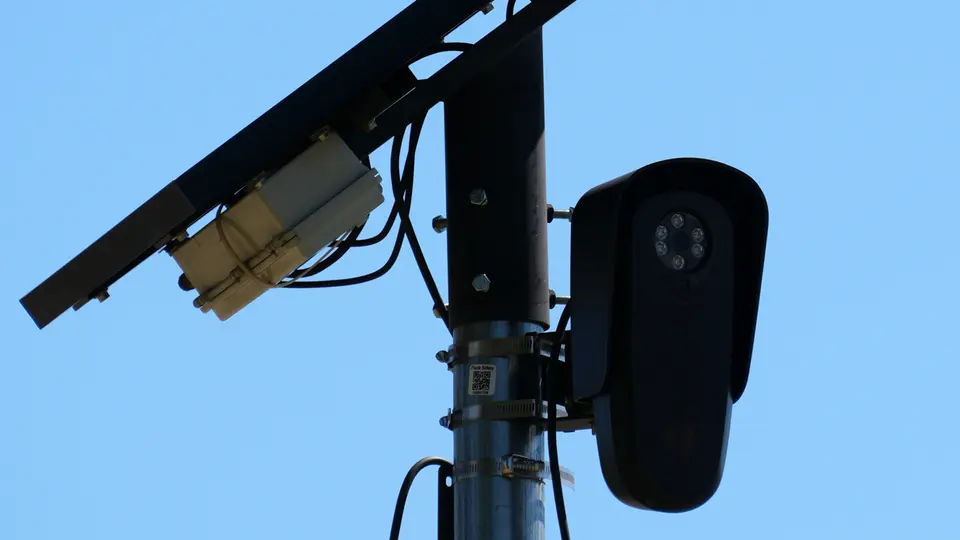
Flock camera installed along U.S. 77 in Waxahachie
Flock cameras are often presented as a modest public-safety tool. In reality, they connect local roads to a much larger system capable of revealing far more than where individuals travel — it can expose patterns about entire communities and society as a whole.